CSEA Africa’s Data Future Fellowship 2026
Job Description
CSEA Africa’s Data Future Fellowship 2026 | $1,500 Stipend
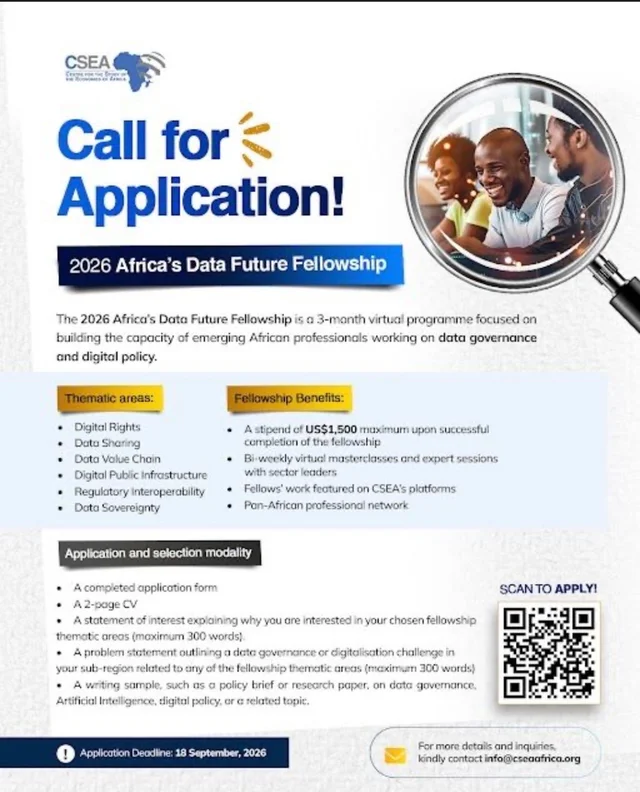
Applications are now open for the 2026 Africa’s Data Future Fellowship, a three-month virtual fellowship organised by the Centre for the Study of the Economies of Africa (CSEA) for emerging African professionals working in data governance, digital policy, Artificial Intelligence and related areas.
Ten fellows will be selected from across Africa for the 2026 cohort. Participants will receive expert-led training, mentorship, professional networking opportunities and a stipend of up to US$1,500 upon successful completion of the fellowship.
The programme begins in October 2026 and is open to eligible applicants from and residing in any African country.
About CSEA
The Centre for the Study of the Economies of Africa (CSEA) is a research organisation focused on producing evidence and policy insights on economic and development issues affecting Africa.
Through the Africa’s Data Future Fellowship, CSEA aims to strengthen the capacity of emerging professionals who can contribute to data governance and digital transformation across the continent.
About the Africa’s Data Future Fellowship
The fellowship is a three-month remote capacity-building programme for early-career professionals and changemakers working within Africa’s data and digital policy ecosystem.
The programme combines virtual expert sessions, independent research and institutional engagement. Fellows will explore important policy questions surrounding how data and digital technologies are governed, shared and used across Africa.
At the end of the programme, each fellow will develop a policy brief and blog post based on one of the fellowship’s thematic areas and present the findings during a dedicated workshop.
Fellowship Thematic Areas
Applicants can focus on any of the following areas:
- Digital Rights
- Data Sharing
- Data Value Chain
- Digital Public Infrastructure
- Regulatory Interoperability
- Data Sovereignty
Programme Structure
- Duration: 3 months
- Start Date: October 2026
- Mode: Virtual
- Number of Fellows: 10
- Languages: English and French
- Time Commitment: At least 2 hours per week
- Sessions: Bi-weekly virtual expert brainstorming sessions and masterclasses
Fellows are also expected to engage with a relevant institution within the data and digital policy ecosystem in their respective countries during the fellowship. This engagement will help disseminate the findings from their fellowship work.
Fellowship Benefits
Selected fellows will receive:
- A stipend of up to US$1,500 upon successful completion of the fellowship
- Bi-weekly virtual masterclasses
- Expert sessions with leaders in the sector
- Professional capacity development in data governance and digital policy
- Opportunity to have their work featured on CSEA platforms
- Access to a Pan-African professional network
- Exposure to professionals and institutions working across Africa’s digital policy ecosystem
The stipend is tied to successful completion of the fellowship and should not be interpreted as an upfront payment.
Eligibility Requirements
Applicants must:
- Hold a postgraduate degree
- Have at least one year of professional experience in social sciences, law, technology, data policy or a related field
- Be from and currently resident in an African country
- Be professionally engaged in data governance, digital policy, Artificial Intelligence, technology or a related area
- Be able to commit at least two hours per week throughout the fellowship
- Have reliable internet access
- Have access to a functional computer throughout the programme
Relevant professional engagement can be within:
- Government institutions
- Private-sector organisations
- AI and technology startups, including fintech, edtech, healthtech and agritech
- Research organisations and policy think tanks
- Universities
- Civil society organisations
Interest or previous experience in public-sector work, data governance, digital policy or technology is an added advantage.
Expected Fellowship Outputs
By the end of the programme, fellows will be expected to:
- Develop a detailed policy brief on one of the fellowship themes
- Produce a related blog post
- Present their findings at a dedicated workshop
- Engage with a relevant institution in their country to support dissemination of their findings
Documents Required for Application
Applicants must submit:
- A completed online application form
- A CV of no more than two pages
- A statement of interest of up to 300 words explaining their interest in their selected thematic area
- A problem statement of up to 300 words identifying a data governance or digitalisation challenge within their sub-region
- A relevant writing sample, such as a policy brief or research paper on data governance, Artificial Intelligence, digital policy or a related subject
Applications must be submitted through the online application system and in English.
Selection Process
Only 10 fellows will be selected for the 2026 cohort. Selection will be competitive and based on applications submitted by candidates who meet the fellowship requirements.
Applicants should therefore ensure that their statement of interest, problem statement and writing sample clearly demonstrate their relevant experience, interests and understanding of their chosen thematic area.
Requirements
Applicants must:
- Hold a postgraduate degree
- Have at least one year of professional experience in social sciences, law, technology, data policy or a related field
- Be from and currently resident in an African country
- Be professionally engaged in data governance, digital policy, Artificial Intelligence, technology or a related area
- Be able to commit at least two hours per week throughout the fellowship
- Have reliable internet access
- Have access to a functional computer throughout the programme
Relevant professional engagement can be within:
- Government institutions
- Private-sector organisations
- AI and technology startups, including fintech, edtech, healthtech and agritech
- Research organisations and policy think tanks
- Universities
- Civil society organisations
Interest or previous experience in public-sector work, data governance, digital policy or technology is an added advantage.
Expected Fellowship Outputs
By the end of the programme, fellows will be expected to:
- Develop a detailed policy brief on one of the fellowship themes
- Produce a related blog post
- Present their findings at a dedicated workshop
- Engage with a relevant institution in their country to support dissemination of their findings
Documents Required for Application
Applicants must submit:
- A completed online application form
- A CV of no more than two pages
- A statement of interest of up to 300 words explaining their interest in their selected thematic area
- A problem statement of up to 300 words identifying a data governance or digitalisation challenge within their sub-region
- A relevant writing sample, such as a policy brief or research paper on data governance, Artificial Intelligence, digital policy or a related subject
Applications must be submitted through the online application system and in English.
Selection Process
Only 10 fellows will be selected for the 2026 cohort. Selection will be competitive and based on applications submitted by candidates who meet the fellowship requirements.
Applicants should therefore ensure that their statement of interest, problem statement and writing sample clearly demonstrate their relevant experience, interests and understanding of their chosen thematic area.
Application Deadline
Deadline: September 18, 2026